Fund your factory automation
Palletizing robot, welding cell, smart conveyor, vision-based inspection: almost all of these investments fall under at least one funding program. The funding is decided before the purchase order, not after.
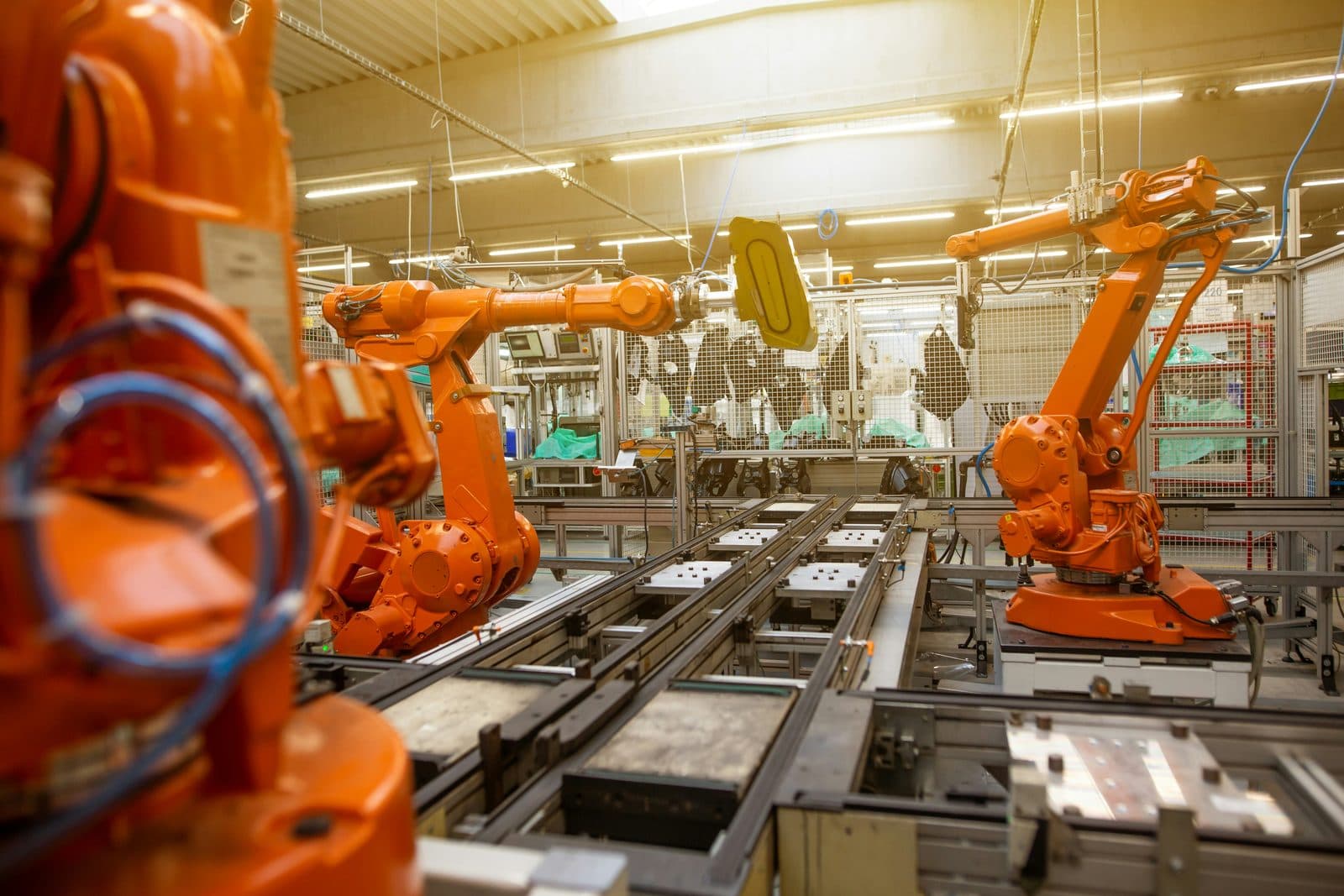
- Robotizing a production line
- Automated welding cell
- Loading and palletizing arms
- Automated conveying and handling
- Machine vision for quality control
- Connecting controllers to existing systems
- Equipment commissioning and programming
- Operator training on the new line
Programs for factory automation
These four programs come up in most automation mandates. They stack, provided the stacking caps are respected and the applications are filed in the right order.
- Provincial · Investissement Québec
ESSOR 1C
ESSOR 1C reimburses half the fees of a study that comes before an investment: technical feasibility, digital diagnostic, productivity plan, site analysis. It is the sub-component used to fund the thinking before the project itself.Continuous intakeUp to $50,000 - Provincial · Revenu Québec
C3i
Continuous intake15% to 25% of the cost of the assets - Provincial · Initiative québécoise pour la construction 4.0
IQC 4.0
ClosedUp to $50,000 under stream 2 IRRT
Planning a project like this?
How funding works for an automation project
An automation project ticks three boxes Canadian funders are looking to support at once: it raises output per employee, it reduces reliance on labour that is hard to recruit, and it leaves a lasting asset behind in the region. That combination is why a single equipment purchase can qualify at the same time for an investment grant, a tax credit on the machinery and — where getting it to work required solving a technical problem — the research credit as well.
So the difficulty is almost never eligibility: it is timing and order. The vast majority of programs reject costs incurred before the application is acknowledged, and a signed deposit with your integrator is enough to take the equipment out of the eligible perimeter. And since each program sets a stacking cap expressed as a percentage of total project cost, the combination that pays the most depends on the order in which the applications are filed.
- 01
The equipment and its installation
Robot, cell, conveyor, controller, vision system, plus the implementation engineering and commissioning.
- 02
Integration with existing systems
Connection to the ERP or MES, sensors, production data capture, and custom-built interfaces.
- 03
Operator training
Bringing the team up to speed on the new equipment falls under programs separate from those funding the machine itself.
- 04
The engineering share
Where integration required resolving genuine technical uncertainty, that portion of the work falls under the research credit.
Frequently asked questions about factory automation
Four programs cover most automation projects. ESSOR 1C, from Investissement Québec, supports investment projects that raise productivity. The C3I, from Revenu Québec, is an investment tax credit on manufacturing and processing equipment. IQC 4.0 funds the diagnostic and the automation plan before the purchase. The RTRI, from Canada Economic Development, targets manufacturers affected by tariffs and funds productivity and automation among other things. On top of those four, the SR&ED credit applies where integration required solving a technical problem with no known solution.
In most cases, no. Investment programs apply the prior-commitment rule: any cost incurred before the application is acknowledged falls outside the eligible perimeter, and a purchase order or a deposit paid to the integrator is enough for the cost to count as incurred. There is one notable exception: tax credits such as the C3I or SR&ED are claimed after the fact, in the tax return for the year concerned. That is why an already-purchased project is not necessarily lost — but it only opens some of the programs.
It depends on the program, and it needs checking before you choose. Investment tax credits generally target new equipment, or equipment never previously used in Canada. Productivity grant programs are often more flexible and accept refurbished equipment, as long as the productivity gain is demonstrated. Because this distinction changes which combination of programs applies, it is settled at the start of the project, not when filing.
Not the purchase itself: installing equipment to the manufacturer's instructions is implementation, not research. What does qualify is the portion of the work where your team had to resolve technical uncertainty — adapting a cell to a product it was not designed to handle, developing control logic that did not exist, hitting a throughput the supplier would not guarantee. That boundary is documented while the work happens; reconstructed a year later, it is far harder to defend.
Hubvention starts from the actual project — target equipment, schedule, budget, expected productivity gain — and matches it against the active federal and provincial programs. The deliverable is not a list of possible programs but a schedule: what to file, for how much, on which date, and in which order to stay under the stacking caps. Hubvention then carries the mandate end to end — technical drafting, filing, defending the file with the agency, and follow-through until payment. The initial assessment is free and without obligation; mandate fees are set case by case in the engagement letter, before any work begins.